Belonging Found: A Chronicle of Loss, Growth, and Discovery.

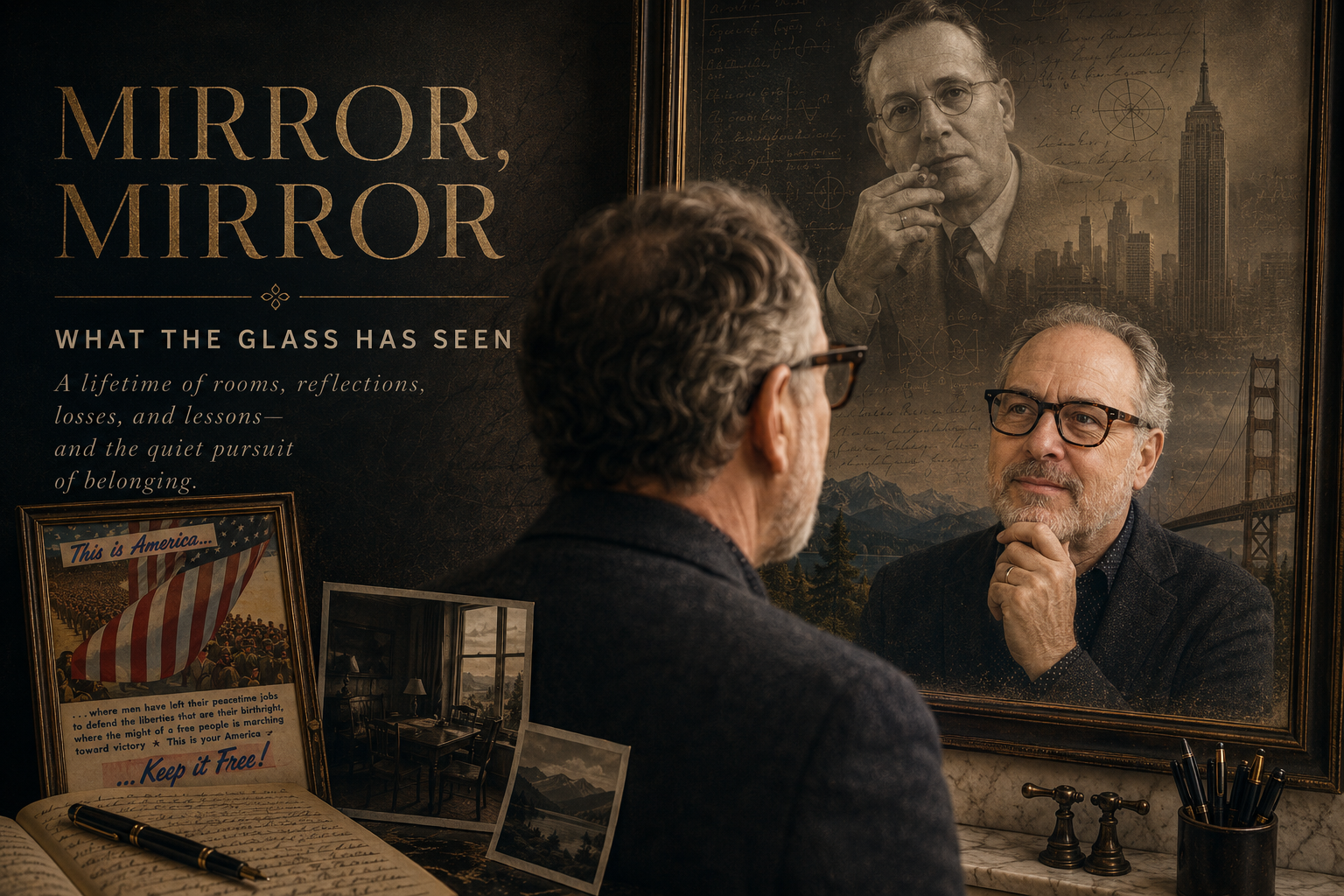
You always said I told the truth and you didn’t — that you could stand here past sixty and tell yourself you were rested and trim, and I would correct you without a word, and that the people who looked at you all day knew you better than you knew yourself. You trusted the glass over the man reflected. So let me, for once, say what I’ve seen. I’ve watched you a long time now, in a great many bathrooms, in a great many cities.
I met a boy who never quite fit in the rooms he was standing in. You came up through schools that ran on their own odd rules — one that gave no grades at all, where you spent your free hours reading whatever you pleased and running the lights for the school’s own gatherings; another you could walk out of the moment your class was done. You carried that into every room afterward: always a half-step outside it, always reading it from the doorway, the way I read a room from the wall. You thought it meant something was wrong with you. It was the other way around. The boy who belongs to no single room is the one who can see across all of them. You weren’t ready to hear that from me before now.
There was a morning you came home from freshman year changed. Eighteen, snow still in your hair, a red eye from Boston to Chicago. You had been studying the same long-dead philosopher in two classes — proving God in one, drawing mathematical graphs in another — and somewhere over Ohio it broke open in you. You had always kept what you knew in separate glass tubes, each sealed off from the next: history in one, mathematics in another, religion in its own. That night you watched the glass shatter, and everything you knew spilled into a single open field where any of it could touch any of it. You looked different to me afterward. You had found the thing you would do for the rest of your life, though you simply called it “thinking”.
Then came the years of the luggage by the door. I watched you pack it and unpack it in one city after another — Chicago, San Francisco, New York, Hong Kong, back to Chicago, Los Angeles, back to San Francisco, back to New York, and at last a house near Seattle. You were good at arriving and good at leaving and never quite good at staying. You called it the work, and some of it was the work. The rest of it was that staying asks a person to belong, and belonging was the one thing you had never quite felt connected to.
I watched the good years, too. Your face on the cover of trade magazines, the headline calling you a big thinker with one eye on what was coming. Ballrooms you had filled with thousands of people. Chief executives who wanted you in the room. And I watched you believe none of it. Someone would tell you that you were brilliant, and the next morning you would stand here and file it under flattery. You built more meaning for more people than almost anyone I have ever reflected, and you kept none of it for yourself. That was the real waste of those years, and I am sorry I could not make you see it. I only show. I cannot convince.
I learned where you went to find what you needed, because you carried it home and I saw it on you. The fountain pens — more than a hundred of them, lacquered and weighted, each one a small private argument that the right object can hold a special thought. The paintings of where someone had just left: an empty bench, a chair pushed back from the table, a diner with 3 customers — pictures that handed you an incomplete story and asked you to step in and finish it. And the posters your grandfather created during the war — a flag, a few bold words, a whole country asked to pull together — the ones that hang in the Smithsonian, that you framed behind your desk and then took down the moment a zoom call turned your office into a stage and people misread them as a different kind of flag you had never meant to wave.
Some mornings, when the light came in a certain way, I did not show you your own face at all. I showed you a familiar and distant one — the grandfather you never met, gone fourteen years before you were born. The same glasses, the same jaw line, the same cigar, same sentiment, same aura. Your grandmother used to say you were him returned. Standing where I stand, I can tell you she was not far wrong. You were never only yourself in this glass.
And I watched the losses, because they reached the glass before you could say them out loud. The pets gone on ordinary mornings with no warning at all. Your father, and then your mother. The collectors’ world you had loved, which slowly became a game for much richer men; the craftsman who used to make time for you and one day simply stopped; the co-workers and friends who don’t have time for you now; and the loud silence their departures have left. You would stand here a little emptier each time. If I could have spoken then, I would have told you what that ache really was: the exact measure of how badly you want to belong.
Not everyone left. One face has stood beside yours in this glass for twenty-five years — the longest you have chosen to stay near anyone, or anything. You do not always notice her there, in the corner of the frame. You should.
Something shifted about four years ago. The work that used to fill your days stopped, and instead of looking for free hours you began to use them. You look at yourself longer now. You ask harder questions. One morning I could see that you had quit trying to be the man who staged other people’s events and started trying to be the man who understood things — who could finally say, plainly, what he was for. You write books now. You hired a genealogist to trace your family back through three empires to the small towns they left hundreds of years ago. You are building, late and on purpose, the belonging no one ever handed you: out of understanding, out of the things you make, out of the sir-name you are the last man to carry, and you have decided to try and create collection of words that just might outlast you.
So here is what I think, since you have finally asked. You are a man who spends his life connecting things that didn’t obviously belong together, and who took sixty years to turn that gift on himself. You went looking for meaning in the loud places — the stages, the titles, the large crowds — and found it, in the end, in the quiet place: in seeking understanding, in writing words, in a handful of people, and in the long lineage you belong to. The disappointment in you is real, and most of it is one disappointment wearing different clothes — you wanted to belong more than you ever let yourself believe yet never had the skills to achieve.
But you have changed in a way I can see from here every single morning. You have begun to look at yourself the way I always have – clearly, and without the doubtful stories from within. That is new, and it suits you. The man in the glass was always more than the one looking in believed. I have known it the whole time. I was only ever waiting for you to ask.